My next review is coming soon dear readers. But until that moment, while I parse over the theological musings of biologist Richard Dawkin's, please enjoy this important message from Kirk Cameron and friend. Is it just me, or is this kinda hot? I just want Kirk to bite into that Banana!
Wednesday, September 26, 2007


Sunday, September 23, 2007
FULL VERSION Dumb Sherri Shepherd thinks Earth is flat
Not Philosophy per se but an invaluable example of the stupidity that runs rampant throughout this country. I am actually confused. Is this for real? Did she really not know the world is round? Aristotle figured this out in 330 BC! I mean, how do you not know? I'm confused. It can't be true. Can it? Can an adult really talk about this issue on television? Does she really make a shitload more money than the rest of us? Maybe now she can afford to buy a...I don't know....a globe. Tomorrow's Hot Topic: Does 2+2=4?
Monday, September 17, 2007
The Nietzsche Family Circus!
Hilarious! Click on the link for more!
In Christianity neither morality nor religion come into contact with reality at any point.
|


Thursday, September 13, 2007
Richard Dawkins to world: Evolve Already!
 Richard Dawkins has more than anyone since Charles Dawrwin (or at the very least since John Maynard Smith)to promote and popularize the theory of evolution as the final word in biology. His books (especially "The Selfish Gene")have become the most widely read text for laymen on the subject. Although he has flirted with it his entire career, Dawkins has now tured his attention to the subject that he thinks is a natural extension of Darwinian thought: atheism. If ever a person has volunteered themselves to be the face and spokesperson of this cause it is Richard Dawkins. Television specials ,an Eurpopean and Amercian lecturing tour, a open slot on the 24/7 cable news cycle whenever they need an atheist go-to mouthpiece and, most of all, a best-selling book. "The God Delusion" has been a suprise hit in America; an affront to all those who, quoting "polls" of the American populace, assert that almost all Americans are church going pious Christians. Dawkins has cetainly faced his fare share of criticism for the book; mostly from other liberal athesist thinkers reviewing the book in various periodicals and newspapers. What's the beef? A philosophic look at Dawkins arguments can shed some light.
Unlike Sam Harris, Dawkins is more thorough and systematic in his argumention. He does his damndest to convince the reader, that God-because of logical constraints- is almost certainly a fictional creation. Although he often thinks of himself as making this point scietifically, he is engaging in philosophy, pure and simple. One might wonder how an evolutioary biologist could be qualified to argue in such a way but, then again, Leibniz was a Mathematician and Ayn Rand a novelist so, why not? What's important is how well he achieves his task. The brunt of his philosophical analyses can be found in Chapters 3 and 4, "Arguments for God's Existence" and "Why there is almost certainly no God." He begins dismantling Aquinas' proofs of God's existence rather, shall we say, unmodestly:
"The Five 'Proofs' asserted by Thomas Aquinas in the thirteenth century don't prove anything, and are easily - though I hesitate to say so,given his eminence - exposed as vacuous."Even if a person believed that dismantling Aquinas is an easy task, better to keep such sentiments to oneself, for in displaying that he doesn't really think Aquinas to be so hard after all, he lessons his own rhetorical power. I would much rather here from someone who found Aquinas incredibly challenging and still rejected him. One's counter-argument must be respected and given all due consideration. In attempting to disprove Aquinas one must first try to convince themself that Aquinas in true. While this is critical of his rhetorical style, and not Dawkins' actual argumentation, it nevertheless betrays a certain chauvenism on his part. After this declamation he goes to a mostly satisfying, if unoriginal, critique of the proof's of God's existence. He handles the problem of infinite regress with aplomb, nearly dismisses the "Argument from Degree" out-of-hand (a move which I have some sympathy for, given the arguments awkwardness and poor formulation) and, evolutionary biologist that he is, provides Darwin as the answer for all problems teleologic (that is, the argument from design.) After dismantling these "a posteriori" arguments for God's existence he moves on to a priori ones, namely the ontological argument. I was happy to see Dawkins dip his toes into these murky waters (something Sam Harris avoided) but was quickly put-off by Dawkins' dismissal of the argument as "infantile," and that the argument belongs "in the language of the playground." Upon reading this I knew that a sophisticated analysis of Anselm was not going to be found in "the God Delusion." Dawkins seems baffled by Betrand Russell's struggle with the issue, owning it up to Russell being "a exaggeratedly fair-minded atheist, over-eager to be disillusioned if logic seemed to require it." Of course, Mr. Dawkins, if logic requires one to believe something there is nothing illusory about it. The question at hand is whether the ontological arguent is really such a logical truth-tout court. All Russell appreciated was that this argument was far more than a school-yard taunt. Dawkins knee-jerk reaction to Anselm is a "suspicion of any line of reasoning that reached such a significant conclusion without feeding in a single piece of data from the real world(itallics mine)" What he fails to appreciate, (and he admits nearly as much when he says that that is why he is a "scientist" and "not a philsopher") is that the ontological argument is metaphysical in scope; empirical evidence can weigh on it neither for or against. If datum from the world made a crucial difference in the ontological arguments truth or falsity it would not be an a priori argument at all. I suspect Dawkins doesn't believe we can gleam much knowledge from a priori reasoning; in fact I don't think he really thinks about the subject much at all-even in how certain a priori assumptions relate to science. Dawkins has a bemused fondness for philosophers, never so evident as when he realtes the story about how he challlenged a group of philosophers to prove that pigs do not fly. They had to resort to modal logic to do so. Those silly philosophers!
He's better than his book!
Here is Sam Harris, responding to an essay by Jonathan Haidt, proving that, when focused, Harris is one the best, linguistically dextrous defenders of atheism and secular morality. If only his book could have shown such discipline.
A RESPONSE TO JONATHAN HAIDT by SAM HARRIS
Wednesday, September 12, 2007
Sam Harris blows his wad.

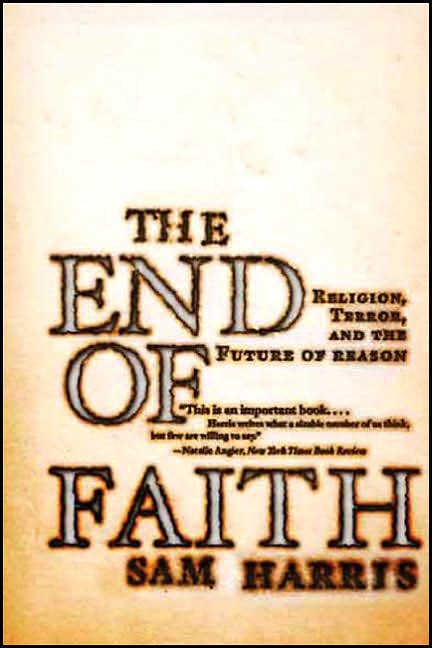
Sam Harris' book The End of Faith is, ostensibly, a book meant to dismantle the notion "faith" and "religion" in contemporary society. That is, he wishes to convince the reader to forgo his belief in "ridiculous" religion and become a reasonable, sober person. I concur with Harris primary thesis that this is a most important change which needs to catch on in 21st Century society. However, the book that Harris has written might as well be called "an introduction to contemporary philosophy" for he often distracts himself with other philosophic issues that he feels a need to expound on.
In "The End of Faith" Harris covers the topics of religion/atheism, epistemology, meta-ethics, the mind/body problem and the phenomenology of the spirit. Toss in a few non-philosophic chapters on the history of brutality in the Christian tradition as well as an analysis of contemporary Muslim and Christian faith and you get an idea of how far-reaching Harris' book attempts to be. Instead of this breadth being a testimony to the grandness of the books goals, it actually hinders it. As anyone who has read philosophy will know, arguments, to be truly convincing, most move slowly. The counter-argument must be presented with total conviction to be adequately refuted. Harris is not one to indulge in such a laborious methodology. Religion is written off from page one as obviously illogical and unreasonable. His deficit of counter-argument leaves me thinking that a true believer would have a hard time renouncing their faith in light of his writing. No mention is made about the many philosophic arguments for the existence of God, and the refusal to address these famous counter-examples leaves his own argument weak. Thomas Aquinas receives nary a word, nor does Anselm's ontological proof of God's Existence (considered the most well reasoned of all the "proofs"). Nor does Harris do much historical biblical scholarship--certainly learning about how the Bible was actually written, and it's historical place in Western Society could convince many readers of the Bible's invalidity. Harris doesn't bother. He is too busy.
Harris realizes that for many people, dare I say most, morality without religion is a contradiction in terms. Harris vehemently disagrees (and I with him.) He does sketch out a bare bones secular ethical theory in the book; a theory that seems, on the surface, to represent a utilitarian perspective. However, utilitarianism is never is directly discussed, nor is Kant and his categorical imperative, both of which are the basis for all contemporary ethical debate. He regulates his decision to avoid these terms to a footnote, "the linkage between happiness and ethics is not a mere endorsement of utilitarianism...I have elected to bypass the categories of moral theory that usually frame any discussion of ethics--utilitarianism and deontology being the most common. I do not believe that these categories are as conceptually distinct, or as useful, as their omnipresence in the literature suggests." That is quite a claim about ethics he has made. Indeed, Harris is shrugging away 300 years (at least) of ethical theory with a mere footnote. Perhaps I am being a tad hyperbolic but, it is clear that, more than his brevity on the subject, it is Harris' cavalier attitude toward the rigor of Philosophic argument that makes him an ultimately unconvincing writer. If he, in the footnote, had explained that it was merely a matter of simplifying the subject for the reader, or keeping focused on his thesis that made him elect to bypass these traditional arguments about morality the educated reader could move on. Instead, he makes a rather ambitious claim about ethical theory, and then feels no need to argue for it. This truly is philosophic chauvinism.
I was also dissapointed that Harris' often spoke of including animals in our moral sphere as sentient creatures but never suggests to the reader, even in a footnote, how such a view of morality might force a person to change some of their habits, particularly in regards to how we use animals for food. He does not even offer further reading on the topic. I agree the book is not about such issues but, when Robert Nozick brought up the issue in "Anarchy, State, and Utopia," it was not entirely germane to that books over-arching argument either. If you are going to bring it up, then...
"The End of Faith" is a potpourri of Harris' intellectual preoccupations. He has little focus or specificity of purpose; he mostly just attacks faith all guns-a-blazing. His actual treatment of philosophical problems (that he himself introduces) are very unsatisfactory. He takes on Free Will in another extended footnote. He positions himself as some variety of determinist (I think; his actual view is hard to discern.) His greatest fallacy in thinking about "free will" is conflating our "thoughts" with our "actions." He is keen to notice that we are not the "author" of our thoughts; they happen to us. From this he implies that we are not the author of out actions as well (all though he does not spell this out in so many words). Now, even an ardent believer in libertarian Free Will can grant that thoughts, like visual stimuli or overwhelming emotions, are unchosen events that happen to an agent. The idea of an action is not reducible to a "thought," or any other phenomenon. Harris' casual dismissal of deeply complicated issues with little more than unsatisfying footnotes is a serious flaw in his argumentation. If anyone should feel how hard the hard problems of philosophy actually are, it's people like Harris who have been educated in the field (at Stanford no less). Philosophy should (has to) be a divide and conquer endeavor; try addressing all the problems of philosophy at once and discover the vortex of confusion that awaits. Instead, any specific philosophical arguments require some up-front, unargued, a priori commitment. These should be as reasonable and uncontroversial as possible. Granted, little in philosophy is free from debate but to get anywhere with our efforts some battles simply must be left to be fought another day. The premises that one uses to argue from should be explicit and either argued for in full or simply just asserted with a note that the author recognizes that the premise is not universally accepted or can itself be a source of philosophic scrutiny. And then, get back to the task at hand. You can't argue for free-will or meta-ethics in a footnote.
The books last chapter deals with consciousness and problems with identity. Strangely, the chapter becomes an endorsement of Eastern philosophy and meditation. Forceful claims are made about consciousness itself and Harris attempts to argue them in light of thinkers ranging from Buddha to Sartre. Certainly Harris' is trying to offer the reader a rational spiritual alternative to dogmatic religious faith but the scope of this chapter is just too broad. He criticizes Western Philosophy for it's inability to recognize what Harris sees as the illusion of normal subjective experience; that is, the experience of the "I" in existence. He endorses a Eastern view that through meditation one can experience consciousness without the "I" being present. Consciousness liberated from the normal modalities of identity and subjectivity. This is all fascinating stuff and his arguments for it seem relatively sound, if sketchy. However, by the time a person reads this chapter the focus of the book has lost nearly all it's coherence. It would have served Harris better to write an entirely different book on this subject and keep "The End of Faith" about what it claims to be about.
Despite my tirade of criticisms above, "The End of Faith" is still to be recommended. In an age where theocracy is on the rise and books like the argument-free "Purpose Driven Life" sells millions (and "inspire" criminals to confess their sins), a book that endorses rationality and faithlessness is sorely needed. I should add that when focused by the format of a debate Harris is perhaps the best solicitor out there for the atheists case. Harris' book is unquestionably geared toward the masses. He would say that it is not a philosophy text. If that was his goal, he has failed. He has written a philosophy book whether he likes it or not. It's just not a very well argued one.
Tuesday, September 11, 2007
The God Question

For most people philosophy begins and ends with one subject: God. When confronted with the inevitable quandaries, metaphysic and moral, that afflict our species an answer is supplied as quickly as the question is asked: God is the answer to all things. The alpha and the omega. The (how I hate even typing it!) "life force" that unites all substances into one. Yes Obi-Wan, the force is with you. But how does this trick work? After all, as theologians throughout the centuries have shown, simply believing in God does not automatically satisfy ones curiosity about these issues. If so what need would there have been for a Thomas Aqinuas (the most important catholic theologian in history) or even Rene Descartes (the father of modern philosophy, mind/body dualist, and French mathematician.) The answer is faith. Most religious people openly admit belief in a "God" which on some fundamental level they cannot possibly understand or describe. Accepting some strange compromised form of epistemological skepticism, under the guise of "God," most individuals then just sidebar all philosophical curiosity and in moments of contemplation, fall back on their "faith." But maybe this is changing. In the past year, Atheism has received more press and broadcast time than it ever has before. The non-believers among us are coming out of the woodwork in droves. The catalyst for this gush of non-belief? Three best-selling books."The End of Faith" by Sam Harris, "The God Delusion" by Richard Dawkins and "God is not Great" by Christopher Hitchens have all landed like a juggernaut in the publishing world and skyrocketed to the top of non-fiction best seller lists. Google these authors and titles; a flood of links and reviews follow. Nonetheless, few of these reviews analyze the books from a strictly philosophical perspective. Acknowledging that the question of God is ultimately philosophical in nature, the following analyses I hope are not superfluous in the dialogue on this watershed issue. I'll comment on each of the books in three separate posts. The first is Sam Harris' "The End of Faith."
Monday, September 10, 2007
The Couch Potato Philosopher welcomes you!

Welcome to The Couch Potato Philosopher! Do you ponder mind body duality while waiting at the McDonalds drive-thru? Do you sometimes feel more Humean than human and then quietly laugh at your own clever pun? Have you ever felt out of place because, while your neighbors and friends are talking about who won Survivor, you're wondering if solipsism is true and if so is all sex really just masturbation? Ok, maybe that's just me. But if this sounds like you at all I have a most serious diagnosis: you probably have a chronic philosophical orientation and, like other certain orientations, it's permanent. So, it's time to embrace the truth, (even if you don't think there is such a thing): you love philosophy and are proud of it. Amateur philosophers everywhere come out of the closet! The basic questions of existence need not be addressed only within the Ivory tower. I know that sometimes you might feel like you just Kant (wink wink) begin to read the dense tangled volumes of literature out there. Does one really need to read the entire Western Philosophic cannon to be able to understand contemporary (and, in turn, eternal) philosophic debates? That's a lot of pressure if you don't have Harold Bloom's schedule. Don't worry, this site is for you. Not only that: it's all about you. The best "academic" blogs are those with the most robust reader interaction and I hope this blog is no different. And guess what, it can also be pretty damn fun! So dust off that old copy of Thus Spake Zarathustra, and Summa Theologica and shout it from the rooftops. "Philosophy rocks!" Believe it or not, those were Socrates real last words.
Subscribe to:
Posts (Atom)
